

One strong brand or a portfolio of independent brands? Sooner or later, growing businesses face this question as they expand their offering, enter new markets or reach new audiences. Business growth brings more than new products and services. It also creates a need to organise how they are presented and understood.
This is where brand architecture comes in. It is the strategic framework that defines the relationships between a master brand, sub-brands, products and services. A well-designed architecture helps customers navigate an offer, strengthens brand recognition and gives a business room to grow without losing its identity.
At Papaja Brand Agency, we see brand architecture as one of the foundations of brand strategy. It is not simply a matter of naming or visual identity. It is a decision about how a brand will operate, communicate and build value over time.
What is brand architecture?
Brand architecture defines how individual brands, sub-brands, product lines and services relate to one another. It establishes which brand takes the leading role, which elements share an identity and how customers should understand the connections within a portfolio.
It can be thought of as the organisational blueprint for a brand portfolio. Instead of a random collection of names and products, a business has a considered system in which every element has a clear role and place.
There is no single model that works for every organisation. The right approach depends on factors such as business scale, portfolio complexity, target audiences, market position and future plans. Two of the most widely recognised models are Branded House and House of Brands, with a range of hybrid solutions in between.
Branded House: One Brand, Many Opportunities
In a Branded House model, the master brand is the central point of reference for the entire offering. Products, services and sub-brands benefit from its name, recognition and established reputation.
Customers primarily see one strong brand, while individual products and services are presented as extensions of it. They may have their own names or descriptors, but they remain clearly connected to the parent brand.
This approach is particularly effective when products and services are related, target similar audiences or share common values. Brand recognition can accumulate across the portfolio: a positive experience with one product can strengthen trust in the others.
FedEx: One Recognisable Brand Across Multiple Services
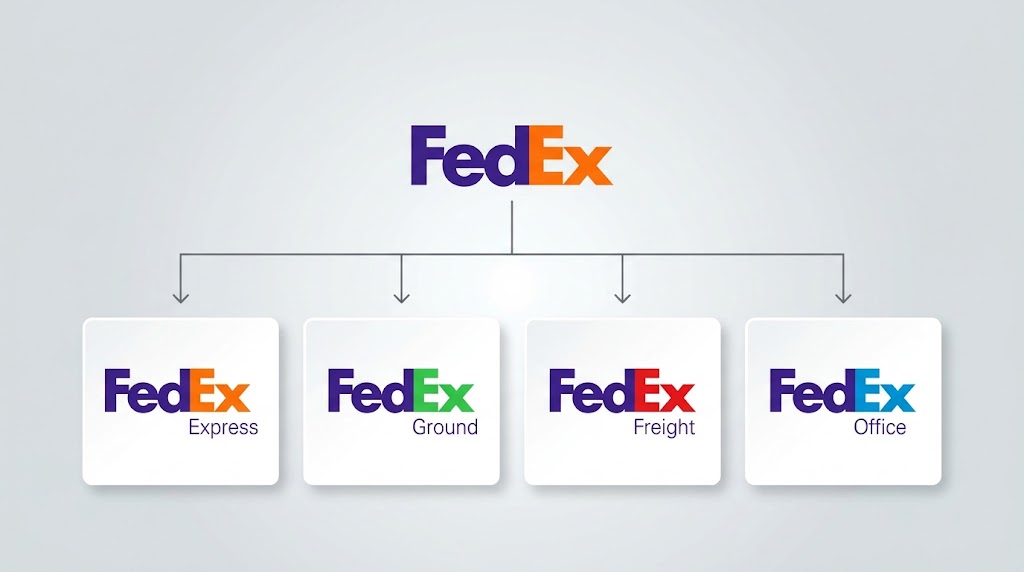
FedEx is a clear example of the Branded House model. Its master brand connects different areas of the business, including FedEx Express, FedEx Ground and FedEx Freight.
Each service addresses different transportation and logistics needs, but all benefit from the recognition and reputation of FedEx. Customers can easily understand that they are choosing different solutions offered by the same organisation.
Pan Steskal: Organising a Brand as the Business Grows
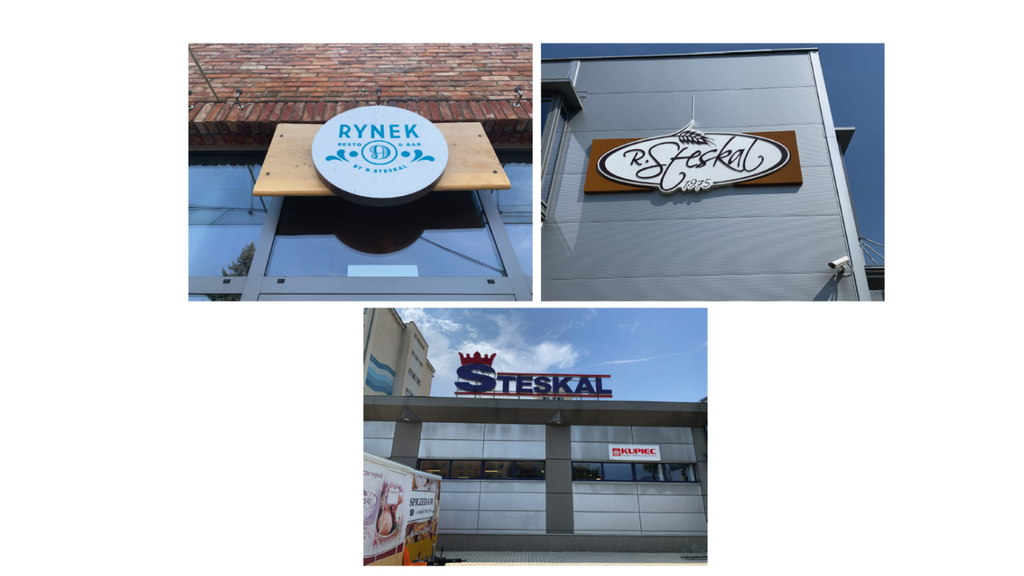
A similar challenge arose with Pan Steskal. As the business developed, it expanded across different formats and customer touchpoints. It needed a clear system that would organise the offering while maintaining a shared brand identity.
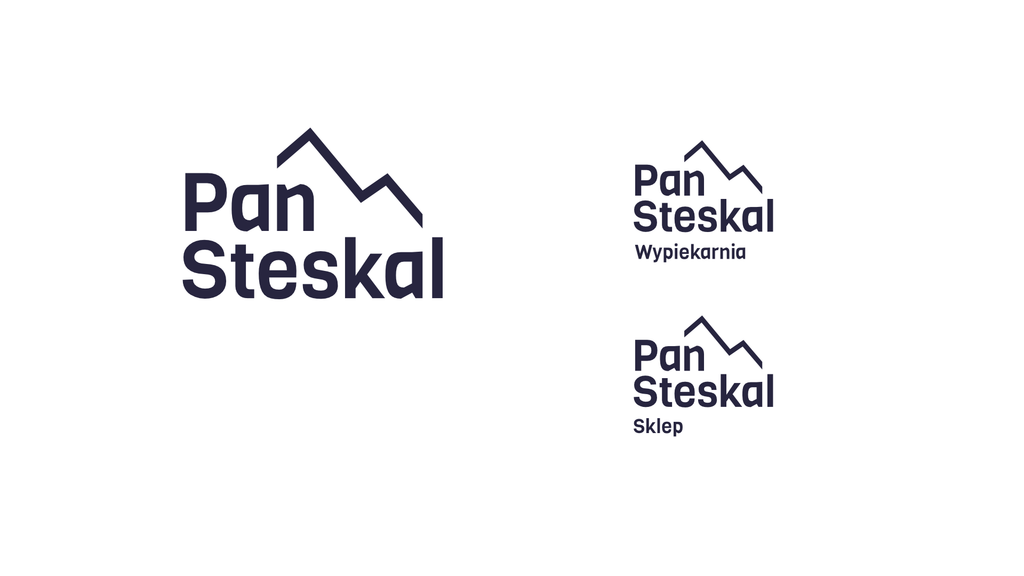
As part of the project, Papaja Brand Agency structured the relationship between the Pan Steskal master brand and its extensions, including Pan Steskal Wypiekarnia and Pan Steskal Sklep. The goal was to create a consistent naming and visual identity system that would help customers recognise the connection between the different formats.
The new visual identity draws on a motif inspired by the mountain landscape, supported by consistent typography and a system of elements that help distinguish the sub-brands. This allows different parts of the business to retain their individual character while strengthening recognition of the Pan Steskal brand.
House of Brands: Multiple Brands, Independent Identities
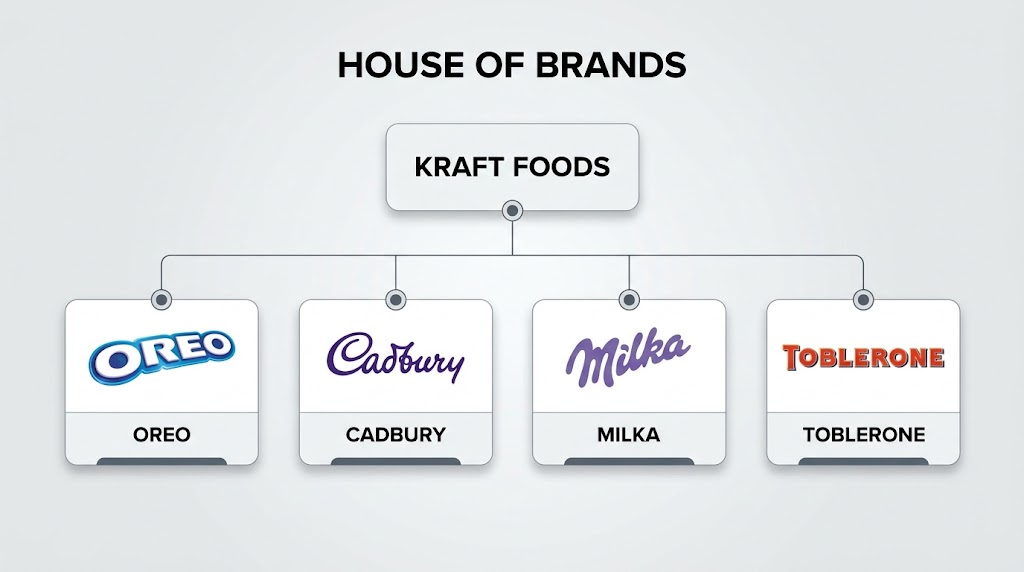
In a House of Brands model, an organisation manages a portfolio of independent brands. Each has its own name, positioning, personality and visual identity. The corporate brand may remain in the background rather than serving as the main focus of consumer communication.
This approach offers considerable flexibility. Individual brands can address different audiences, operate in separate price segments and build distinct associations. It can also limit the direct transfer of reputation between brands, whether positive or negative.
However, a House of Brands structure is more demanding to manage. Each brand needs its own strategy, communication and often a separate visual identity system. This means greater investment in branding, marketing and maintaining consistency across the portfolio.
Kraft Heinz and Mondelēz International: Different Brands for Different Audiences
The Kraft Heinz portfolio illustrates how a business can operate through multiple well-established consumer brands. Kraft, Heinz, Philadelphia and Oscar Mayer each have their own positioning, character and communication. Customers choose the individual product brand rather than necessarily engaging with the corporate name behind the portfolio.
A similar approach can be seen in the portfolio of Mondelēz International, which includes brands such as Oreo, Milka, Cadbury and Toblerone. Each has its own history, visual language and relationship with consumers.
It is important to note that Kraft Heinz and Mondelēz International are two separate companies. Their portfolios are independent examples of organisations managing multiple brands.
Hybrid Brand Architecture: A Balance Between Two Models
In practice, brands rarely follow one textbook model exclusively. Many organisations choose a hybrid architecture that combines elements of Branded House and House of Brands.
The master brand may act as an umbrella for some parts of the portfolio, while other products or business lines operate under more independent names. Sometimes the shared element is the name; in other cases, it is a visual mark, colour system or distinctive communication style.
This approach allows businesses to adapt their architecture to different categories and markets. It also requires clear principles defining when brands should look and sound alike, and when they need greater independence.
Sol-Millennium: A Consistent System Across Different Product Areas
Sol-Millennium is an example of this approach in a project developed by Papaja Brand Agency. The company operates in the medical products sector, with an offering that includes several lines addressing different needs and professional audiences.
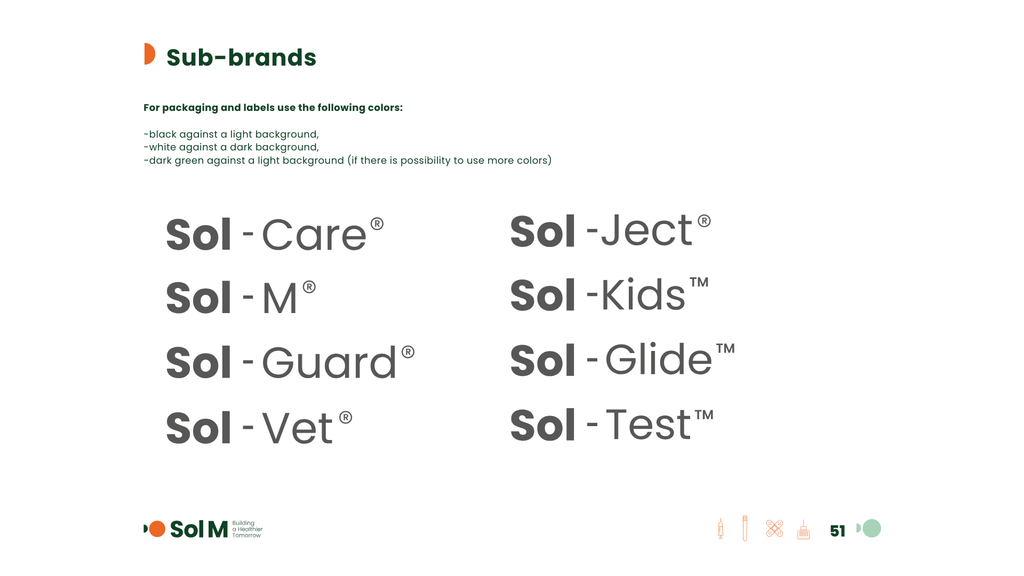
The challenge was to create a system that would preserve the shared Sol brand element while making the individual areas of the portfolio easy to distinguish. The architecture includes Sol-Care®, Sol-Guard®, Sol-Vet®, Sol-Kids™, Sol-Ject®, Sol-Glide™ and Sol-Test™.
The shared name helps build recognition across the portfolio, while the individual line names make each offer easier to identify. It is an example of an architecture that combines the consistency of a parent brand with functional differentiation.

Branded House or House of Brands: How to Choose the Right Model
Choosing a brand architecture should not be based solely on the current number of products or sub-brands. It is a strategic decision that needs to consider the company’s direction, as well as the way customers make decisions.
A Branded House is a strong option when the master brand has an established position and individual products or services can benefit from its reputation. It helps build recognition, organise communication and make better use of shared marketing resources. At the same time, experiences in one area of the business can influence how the entire brand is perceived.
A House of Brands works well when a portfolio covers clearly different categories, audiences or positioning strategies. It gives individual brands more independence and allows each to develop its own strategy. In return, it requires greater investment and more complex portfolio management.
A hybrid model may be the right choice for organisations that need both consistency and flexibility. It allows brands to differentiate where necessary while benefiting from the strength of the master brand where that creates the most value.
The question is not which model is universally better. The important thing is choosing the one that best supports the business, its customers and its long-term ambitions.
How to Develop a Brand Architecture
A successful brand architecture starts with understanding the business. Before creating names, logos or visual identity systems, it is essential to define the role of every element within the portfolio.
The process should include several key stages:
1. Understanding the current situation
The first step is to review the company, its offering, brands, products and target audiences. This also includes analysing competitors, existing communication and how customers understand the relationships between different parts of the portfolio.
2. Defining objectives and strategy
Brand architecture should support clear business goals. These may include organising existing brands, launching a new product line, carrying out a rebrand, entering new markets or preparing the company for further growth.
3. Choosing the model and defining brand relationships
At this stage, we determine which brands should be closely connected, which need greater independence and what role the master brand should play. We also establish naming principles, hierarchy and the way the portfolio should be presented.
4. Naming and visual identity
The strategy is translated into tangible design solutions. These may include naming, logo design, a visual identity system, packaging, communication materials and brand guidelines that define how the brand should be used.
5. Implementation and ongoing development
Brand architecture needs to work beyond a strategy presentation. It must support everyday communication and sales. That is why it is important to create a system that can be applied consistently and developed as the business changes.
Brand Architecture as an Investment in the Future
A brand grows alongside the business. New products, services, markets and audiences emerge. Without a considered structure, a portfolio can gradually become difficult to understand – both for customers and for the organisation itself.
A well-designed brand architecture helps prevent that complexity from turning into confusion. It supports better decisions, strengthens recognition and creates a foundation for future growth. It also provides a starting point for further branding, rebranding, visual identity and communication projects.
At Papaja Brand Agency, we combine strategic thinking with design. We help businesses organise their portfolios, define relationships between brands and translate strategy into coherent visual and communication systems.
Because a strong brand is about more than good design. It also needs a clear structure that allows it to grow.